
Understanding and Treating Anterior Ankle Impingement in Skiers
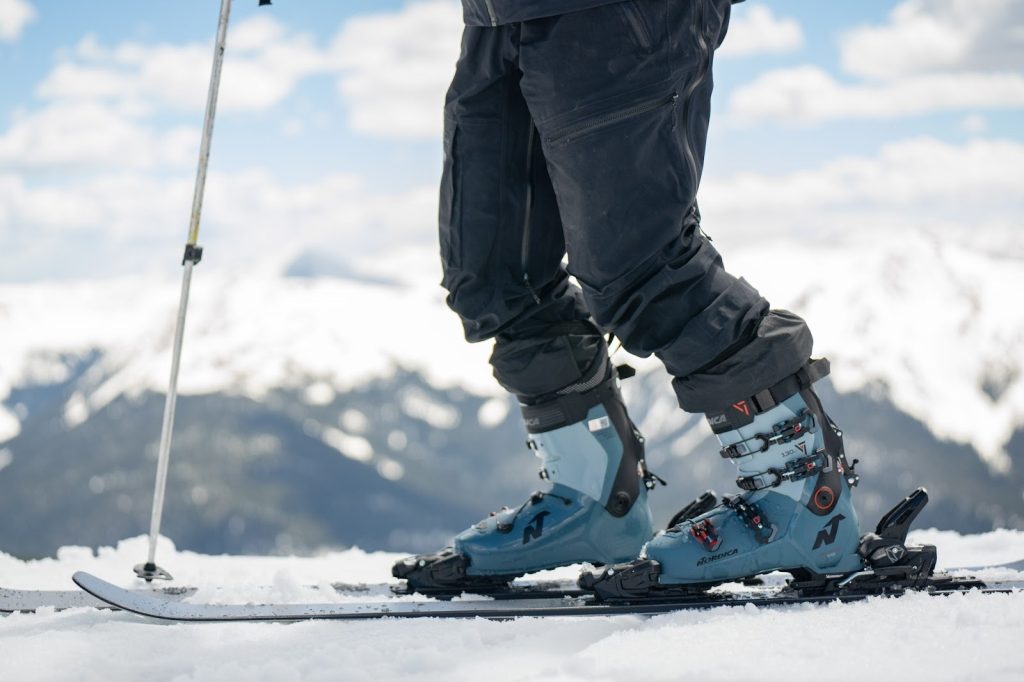
If you feel pain in the front of your ankle when you flex forward in your ski boots, you are not alone.
Ski boots are rigid. They hold your ankle in sustained dorsiflexion — a forward-bent position that improves edge control and performance. But that same position increases compression at the front of the ankle joint.
For some skiers, that repetitive compression leads to anterior ankle impingement.
This is not “just tight calves.”
It is a mechanical compression problem.
What Is Anterior Ankle Impingement?
The ankle joint is formed by the tibia sitting over the talus. When you bend forward (dorsiflex), the talus glides backward under the tibia.
In ski boots, that motion is:
- Sustained
- Load-bearing
- Often forced beyond your natural range
Over time, the soft tissues at the front of the ankle can become irritated. In some cases, small bone spurs develop along the front of the joint, reducing available motion and increasing pinching.
Skiers often describe:
- Sharp pain in the front of the ankle
- A pinching sensation when flexing forward
- Pain walking downhill after removing boots
- Stiffness that worsens throughout the season
Unlike running, skiing keeps the ankle in one position under load for hours. Compression plus time leads to irritation.
Why Skiing Triggers It
Ski boots create a fixed forward lean angle. If your natural dorsiflexion range is limited — whether from prior sprains, tight posterior capsule, or subtle bony anatomy — the boot forces you into that position anyway.
Risk factors include:
- History of ankle sprains
- Limited dorsiflexion
- Very stiff boots
- Aggressive skiing style
- Long ski days on steeper terrain
Two skiers can wear the same boot. Only one develops pain. That difference is usually anatomy and mechanics.
How We Evaluate It at Lighthouse Foot and Ankle Center
The first step is determining what type of impingement you have.
Is it:
- Soft tissue inflammation and synovitis?
- Scar tissue from prior sprains?
- True bony impingement from anterior osteophytes?
Weight-bearing X-rays are often helpful. In persistent cases, MRI may be appropriate. The treatment depends on the underlying cause.
Clarity matters. This is not a one-size-fits-all problem.
In-Office Treatments for Anterior Ankle Impingement
Treatment focuses on reducing inflammation, improving joint mechanics, or addressing structural compression.
1. Boot and Load Modification
Sometimes a small mechanical adjustment makes a large difference.
A temporary heel lift reduces dorsiflexion demand and decreases anterior joint compression. For skiers, this may involve:
- Heel lifts in daily shoes
- Boot board adjustments
- Custom orthotic modification
2. Ultrasound-Guided Injection
If acute inflammation is driving symptoms, a precise intra-articular corticosteroid injection can calm synovitis and reduce pain.
This does not remove bone spurs. It reduces inflammatory response and allows improved motion.
For skiers mid-season, this can be an effective way to continue activity while addressing the underlying mechanics.
3. Shockwave Therapy
For chronic soft tissue thickening or capsular irritation, radial pulse therapy can stimulate tissue remodeling and improve healing response.
Shockwave does not remove bone, but it can improve soft tissue adaptability and reduce persistent pain.
4. Class IV Laser Therapy
Laser therapy can reduce inflammation and support tissue recovery, particularly in cases of capsulitis or post-injection inflammation.
It works best as part of a structured treatment plan rather than as a standalone solution.
5. Joint Mobilization and Strengthening
If dorsiflexion is restricted due to capsular tightness rather than bone, manual mobilization and structured strengthening can improve mechanics.
Strengthening the posterior chain and improving talar glide can reduce anterior compression during forward flexion.
This is often overlooked — and frequently effective.
What Does Not Usually Help
Aggressive calf stretching often worsens true impingement. Forcing dorsiflexion into a compressed joint increases anterior pressure.
The goal is not to push through compression.
The goal is to reduce it.
Why This Matters for Maine Skiers
Skiers are meticulous about tuning edges and waxing skis.
But most ignore ankle mechanics.
If your boot and your joint do not match, your body absorbs the mismatch.
Early treatment is simpler. Chronic impingement becomes more stubborn over time.
If you are dealing with persistent front-of-ankle pain this ski season, we’re happy to evaluate your mechanics and discuss a structured plan.
Lighthouse Foot and Ankle Center, PC
23 Spring St., Suite B
Scarborough, Maine 04074
207-774-0028
www.lighthousefootandankle.com
Front-of-ankle pain in ski boots is common.
It is not normal — and you do not have to ski through it.
